
What Officials Should Consider When Travel Time Shapes Assignment Decisions
When travel time starts competing with rest time, officials need a practical way to decide which games fit the week. Clear venue distance, travel windows, and back-to-back scheduling can help crews accept assignments they can realistically cover.
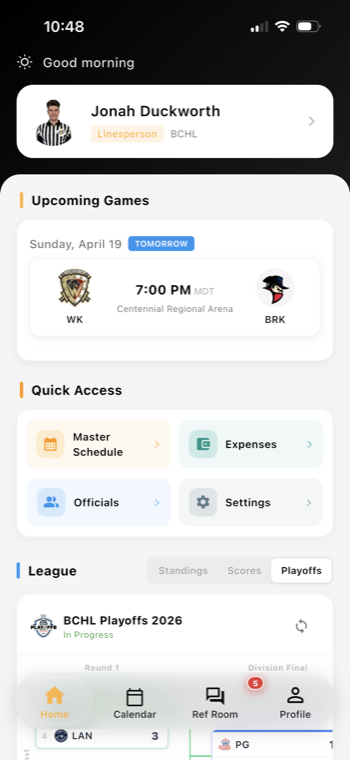
Travel time is one of the most practical factors in officiating, but it is still easy to treat it as an afterthought. A game may look open on paper and still be a poor fit once you account for distance, traffic, venue access, warm-up time, and the next game on the calendar. For assignors and officials, the goal is not to make travel disappear. It is to make travel visible early enough that acceptance decisions are realistic.
In a busy week, that visibility protects everyone. Officials are less likely to accept a game they cannot reach comfortably. Assignors spend less time reworking the schedule after a late decline. Leagues get crews that arrive with enough time to prepare instead of rushing in from another rink or field. When travel is handled well inside referee assignment software, it becomes part of the scheduling conversation instead of a problem discovered on game day.
Why travel windows matter before an official accepts
A travel window is the time an official actually has between events, not just the time listed on the schedule. That window needs to absorb the real-world details that affect arrival:
- Distance from the previous venue to the next one
- Typical traffic at that time of day
- Parking or facility check-in delays
- Time needed to change, stretch, and review notes
- Whether the official is working alone, with a partner, or on a full crew
If an assignment is only 45 minutes away by map but the official has a game ending right before it, the effective window may be too tight. That is why many assignors now want a scheduling view that helps them compare start times, venues, and official availability together. When travel is visible alongside the rest of the schedule, it becomes much easier to spot assignments that need a second look.
How back-to-back games change the acceptance decision
Back-to-back assignments are not automatically a problem. In some leagues, they are normal and manageable. The issue is whether the second game still allows enough recovery time for the official to work safely and perform well.
Officials usually weigh a few questions before accepting back-to-back games:
- Is there enough time to leave the first venue and reach the second one?
- Does the second venue require a different level of preparation?
- Will the official have a break to eat, hydrate, or reset?
- Is the second assignment in the same division, or does it require a different pace and rule context?
- Does the total workload still fit the week?
That last question matters. A schedule can look reasonable game by game and still overload an official when several back-to-backs stack up across multiple days. For developing officials in particular, travel-heavy weeks can turn into fatigue-heavy weeks. Clear assignment notes help officials decide when a game is a good fit and when it is better to decline early.
What assignors can make visible in the assignment workflow
Assignors do not need to solve every travel issue manually. They do need enough context to schedule with fewer surprises. A practical workflow usually includes:
- Venue location or rink/field identity
- Expected arrival time or check-in guidance
- Notes about parking, access, or entry procedures
- The official’s already accepted games for that day
- A simple view of open space between assignments
That is especially useful in Assignments and Scheduling, where the person filling games can see more than just an empty slot. A good assignor dashboard helps the scheduler compare open games against existing commitments, rather than guessing whether an official can realistically cover both. It also helps reduce the kind of last-minute back-and-forth that happens when travel assumptions turn out to be wrong.
For officials, the most helpful information is often the simplest. If the assignment screen or mobile app shows venue distance, start time, and surrounding games clearly, they can make a faster and more informed acceptance decision on the spot.
Making travel part of official development, not just logistics
Travel expectations are also part of development. Newer officials often need help learning how much time they should leave between venues, when a tight turnaround is too tight, and how to protect performance when their week gets busy. That guidance helps them build habits that last beyond one season.
A mobile workflow can support that growth by keeping assignment details, availability, and communication in one place. The Referee Companion App is useful here because officials can review a game before they accept it, rather than discovering a travel problem after the fact. That supports better decision-making without forcing assignors to send repeated reminders for every game.
Over time, the habit becomes simple: review the venue, check the window, think about the rest of the day, and accept only what fits. That is a healthier standard for officials and a more stable schedule for the league.
Travel will always be part of officiating. The difference is whether it is handled late and reactively, or early and clearly. When officials can see venue distance, back-to-back games, and rest time before they accept, they are better positioned to manage the week and show up ready to work.
Want cleaner referee operations?
Ref Buddy connects schedules, officials, crew communication, expenses, and reports so leagues can spend less time chasing details.
Schedule a Demo